Tracking employee working hours in Germany is no longer just a matter of operational efficiency—it's a legal obligation. As workplace expectations evolve and regulations tighten, small and medium-sized businesses, HR managers, and team leaders must stay up-to-date with compliance, data privacy, and practical best practices. This comprehensive guide to working hours tracking in Germany for 2026 covers everything you need to know: legal requirements, digital solutions, practical examples, and actionable advice for successful implementation.
Introduction: Why Working Hours Tracking Matters
In Germany, the conversation about tracking employee working hours has shifted from being merely a question of productivity to being a matter of legal compliance and employee well-being. With increased enforcement, landmark court rulings, and high expectations from both employees and authorities, businesses of all sizes must get working hours tracking right.
Who needs this guide?
- Small and medium-sized businesses (SMEs) setting up or reviewing their compliance processes
- HR and office managers navigating regulatory changes
- Team leaders and business owners aiming for operational efficiency and legal certainty
- International employers with staff in Germany
This article offers step-by-step, practical advice, giving you clarity and confidence to navigate Germany’s rules for working hours tracking as of 2026.
Legal Context: Germany’s Requirements for Working Hours Tracking
Germany’s approach to working hours tracking is shaped by both national and EU legislation. In recent years, landmark court decisions and pending updates to the Working Time Act (Arbeitszeitgesetz, ArbZG) have increased the focus—and requirements—on transparent, reliable time recording.
Who Is Affected?
Most businesses in Germany are subject to working hours tracking obligations. The requirement applies to:
- All employers, regardless of company size
- All employees, including part-time and remote workers
- Exceptions: Some high-level executives are exempt, but only under specific legal definitions
Even small companies and startups with only a handful of employees must comply. For more on specific obligations, see our guide on the legal duty to record working hours.
What Must Be Tracked?
At a minimum, German law currently requires tracking:
- Start and end time of daily working hours
- Total hours worked per day
- Overtime hours and deviations from standard working time
- (If applicable) Breaks and rest periods
Pending legal reforms may further specify details, but the safest approach is to record all hours worked, including remote and flexible arrangements. For a deeper dive, visit Working Time Act requirements.
How to Track Working Hours: Methods & Examples
There is no “one size fits all” method for working hours tracking in Germany. The law grants flexibility in how you record time, provided the records are complete, accurate, and can be produced on request.
Manual vs. Digital Tracking
| Method | Pros | Cons |
|---|---|---|
| Paper forms / Excel | Simple, low-cost, easy to start | Error-prone, hard to audit, not scalable |
| Physical time clocks | Clear records, good for on-site staff | Expensive hardware, less flexible |
| Digital time tracking software | Automated, scalable, secure, integrates with payroll | Learning curve, setup time, cost |
Manual methods (paper timesheets, Excel) may seem attractive but quickly become unmanageable as teams grow or remote work increases. Digital solutions—especially those designed for the German market—offer audit trails, data privacy controls, and integrations needed for hassle-free compliance.
Practical Example: Small Team Implementation
Scenario: A 12-person marketing agency in Berlin wants to comply with working hours tracking laws and manage hybrid work.
Steps to Implement:
- Define Rules: Set standard working hours, core times, and break policies in the employee handbook.
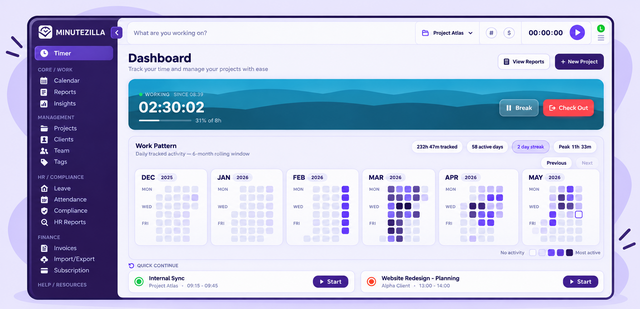
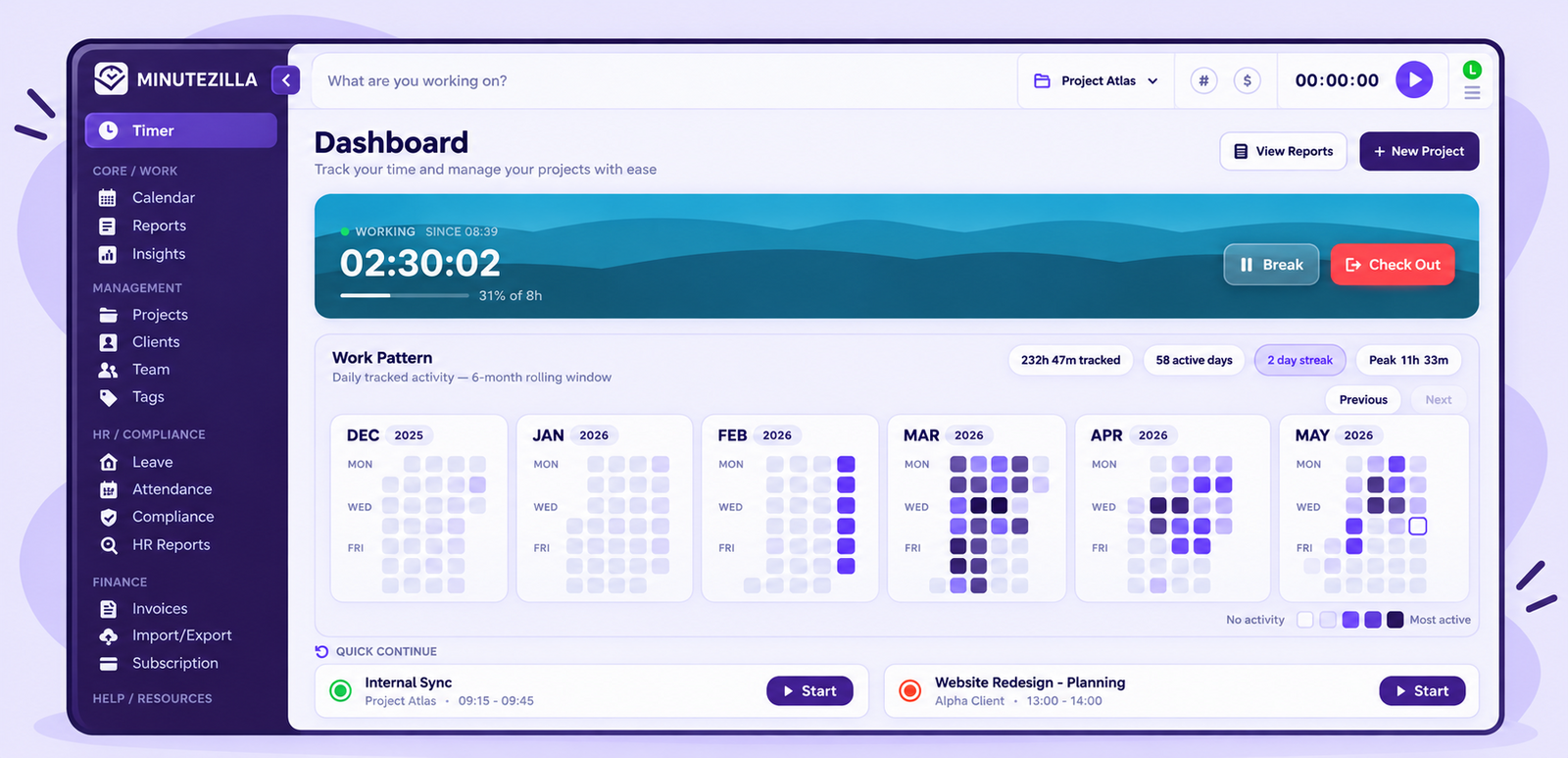
- Select a Method: Adopt a digital solution like Minutezilla for easy onboarding and mobile use.
- Onboard Staff: Train staff on how to clock in/out, record breaks, and check their timesheets.
- Regular Checks: HR runs weekly reports to verify accuracy and address anomalies.
- Data Storage: All records are stored securely for at least two years, as required.
Outcome: The team tracks hours via app or browser, the employer meets compliance obligations, and staff have visibility into their own time records.
Try Minutezilla for free
Time tracking, attendance, breaks and leave in one tool. Right in the browser, no credit card.
Best Practices for Effective Working Hours Tracking
Doing the bare minimum is risky. Effective working hours tracking in Germany is about more than ticking a box—it’s about embedding transparency, fairness, and efficiency into company culture.
Data Privacy and GDPR Considerations
Germany’s strict data protection rules mean time tracking must comply with the GDPR (DSGVO). Employers must:
- Limit access to time data to authorized personnel
- Inform employees about what is being recorded and why
- Store data securely and only as long as necessary
- Allow employees to access their own records
For best practice advice, see GDPR and time tracking.
Avoiding Common Mistakes
1. Incomplete or inconsistent records:
Not tracking breaks or missing remote work can lead to fines.
2. Over-reliance on manual input:
Manual entries are prone to errors and disputes.
3. Poor communication:
Employees should know how to use the tracking system and understand why it’s necessary.
4. Ignoring mobile/remote staff:
All work, including offsite or home office tasks, must be tracked.
5. Data privacy breaches:
Improper handling of time records can trigger data protection violations.
Choosing the Right Software for Your Business
With legal changes and the rise of flexible work, digital working hours tracking is now the standard for most German businesses. Choosing the right solution is essential—not only for compliance but for streamlining HR and payroll processes.
Key Features for the German Market
Look for software that offers:
- German-language interface & support
- Compliance with German labor and data protection laws
- Flexible tracking (app, web, hardware terminals)
- Audit trails and exportable reports
- Role-based access control (HR, admin, employee)
- Integration with payroll and accounting systems
- Secure, DSGVO-compliant data storage in the EU
Minutezilla is tailored for German SMEs and teams, offering all these features and more.
Comparing Software Solutions
Below is a quick comparison of some leading platforms for working hours tracking in Germany.
| Feature | Minutezilla | Clockify | Clockodo |
|---|---|---|---|
| German compliance | ✓ | Partial | ✓ |
| DSGVO-compliant hosting | ✓ (EU) | Partial | ✓ |
| Language & support | English UI, German support | English | German/English |
| Mobile & web tracking | ✓ | ✓ | ✓ |
| Payroll integration | ✓ | Limited | Partial |
| Free plan available | ✓ | ✓ | ✗ |
| Transparent pricing | See pricing | ✓ | ✓ |
| Comparison details | See details | See details |
Sample Working Hours Tracking Table
To visualize how digital time tracking works in practice, here’s a sample table that could be generated by a solution like Minutezilla:
| Date | Employee Name | Start Time | End Time | Breaks (min) | Total Hours | Overtime (min) | Notes |
|---|---|---|---|---|---|---|---|
| 2026-06-10 | Anna Wagner | 08:15 | 17:00 | 45 | 8:00 | 15 | Remote work, normal day |
| 2026-06-10 | Ben Weiss | 09:00 | 17:30 | 30 | 8:00 | 0 | In-office, external mtg |
| 2026-06-10 | Carla Meyer | 07:45 | 16:30 | 45 | 8:00 | 0 | Field work |
This level of detail enables quick audits, transparent payroll, and legal compliance.
FAQs: Working Hours Tracking in Germany
Is working hours tracking mandatory for all companies in Germany?
Yes. German law requires nearly all employers to track working hours for their employees, regardless of company size or industry. Certain executive-level roles can be exempt, but most employees (including remote workers) are covered. Read more on the legal obligation.
What data do I need to record under German law?
You must record the start time, end time, total hours worked, and (if applicable) breaks and overtime. It’s best practice to also note deviations, remote work, or absences. Pending reforms may clarify or expand these requirements.
Can I use Excel or paper forms for tracking?
Technically, yes, but these methods are risky for most businesses. Manual systems are prone to errors and are difficult to audit. Digital solutions offer better security, transparency, and compliance.
How long must working hours records be kept?
At least two years. For some industries or in the case of disputes or audits, longer retention may be necessary. Always check sector-specific rules.
Are employees allowed to see their own time records?
Absolutely. Under both German labor law and the GDPR, employees have the right to access their own working time data. Make sure your system supports this.
Conclusion & Next Steps
Working hours tracking in Germany is a critical task for every employer, not just to meet legal requirements but to foster transparency and trust in the workplace. With enforcement rising and regulations evolving, now is the time to review your processes, choose a compliant software solution, and make time tracking a seamless part of your business.
Key takeaways:
- Every employer must record employees' working hours, including remote and flexible work
- Manual solutions are risky and hard to scale—digital platforms are the new standard
- Compliance requires attention to data privacy, transparency, and regular audits
- The right software not only meets legal requirements but also boosts efficiency
For detailed guidance on related topics, browse our article archive or learn more about Minutezilla’s team features.
Call to Action: Get Started with Minutezilla
Ready to simplify your working hours tracking and stay compliant in Germany?
Get started with Minutezilla today and empower your business with secure, efficient, and legally compliant time tracking—tailored to the needs of German SMEs and growing teams.
Further Reading:
- German Working Hours Tracking Obligation
- Working Time Act Overview
- GDPR & Time Tracking
- Compare German Time Tracking Software, Clockodo comparison
- How to Choose Digital Time Tracking
Disclaimer: This article is for informational purposes only and does not constitute legal advice. For specific legal advice, please consult a qualified attorney or legal adviser familiar with German labor law.